
Colin Edwards, co-creator of the brilliant Franz Kafka Big Band, is also one of my favourite movie bloggers. In his recent critique of Mary Queen of Scots, he admits that British and Scottish history tends to make him glaze over, especially anything to do with Kings and Queens and succession. I don’t think he’s alone and, were it not for the passion of my late Auntie Jean and Uncle Jimmy, I doubt I would have grown up with any knowledge of Scottish history before World War 2. It was they who took me and my sister on tours of historic sites and battlefields around Stirling and Clackmannanshire and made the whole thing come alive.
Colin’s musings also reminded me of the time I persuaded journalist and former SuperScot presenter, Jane Franchi, to take part in the radio mocumentary I made about my alter ego, Johnny Sellotape. In one sequence, Johnny gets a last-minute invitation to appear on this famous BBC Scotland quiz show – a show which tested contestants’ knowledge of all things Scottish – and which regularly attracted record viewing figures.
But much like you can be sure of getting some correct answers on University Challenge by shouting “Shakespeare” , “Beethoven” or “Einstein” at the telly, Johnny had his own game-winning strategy …
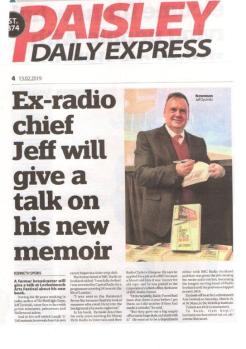
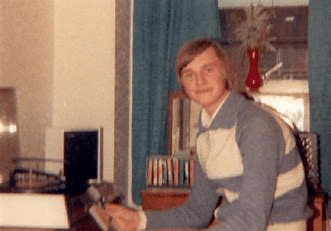
Despite appearances, I’m not front page news in today’s edition of the Paisley Daily Express. Blame the cuttings service for that. I’m actually on page 4 and, as the photograph proves, I will need to get back in shape if I’m ever to make it to Page 3.
What I’m enjoying most about popping up in a paper read by Paisley ‘buddies’ is that I know it will cause maximum embarrassment to my daughter, who works in the local hospital there. This is sweet revenge for a story in yesterday’s Herald Diary in which her expertise as a radiographer allowed her to puncture my pomposity during a recent speech. Asked why I had left the BBC, I told an audience that there is such a thing as a ‘BBC Lifer’ . These are the folk who, it is said, you could cut them open and, much like lettered holiday rock, it would say ‘BBC’ all the way through. I explained that I never wanted to be a ‘Lifer’ and that if you cut me open it might just say ‘Radio’ all the way through.
My daughter, without recourse to her armoury of x-ray machines and scanners, disagreed . With some authority she vouchsafed the opinion that ‘if you cut my Dad in half, all you would see is fat and gristle.”

I’m looking forward to the launch of BBC Scotland’s brand new television channel at the end of the month and the new News programme – The Nine – boasts an incredible line-up of journalistic talent. A photograph of that line-up up has been on many websites and newspapers today and it reminded me of the time, back in 1998, when I tried to create the most impatient news programme every devised with a cast of talent that would be able to predict events before they happened.
Alongside journalists like Gary Robertson, Ken MacDonald and Maggie Shiels we recruited astrologer Lynne Ewart, comedian Bruce Morton, footballer and poet Jim Leishman and weather forecaster (and subsequent MSP) Lloyd Quinan. All our panellists had to do was match their predictions against the views of the public as sampled in an opinion poll. This Christmas special was intended as a pilot for what would have been called Next Week’s News and the format would have allowed us to test the accuracy of those opinions week by week.
Yet, it didn’t quite work. Too complicated? Too many panellists? A faulty crystal ball? Who knows?
But I’m sure The Nine and the new TV channel will be a roaring success. At least, that’s my prediction.
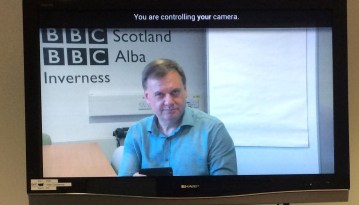
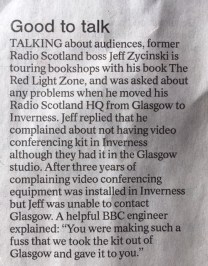
Ken Smith’s diary column in the Herald today picks up the story of my efforts to get video-conferencing equipment installed in the BBC’s Inverness offices. This, I was assured, would spare me from so many car and train journeys to and from Glasgow, but three years after moving Radio Scotland’s nerve centre to the Highlands, there was still no sign of the camera and screen. I stamped my feet, threw around terms like ‘carbon footprint’ and one day, the kit was installed in a meeting room. It was the same meeting room we used to store boxes of excess toilet rolls, but an angled sitting position and careful positioning of the camera made it look professional. All was not well, though, and it was only when we had tried and failed several times to make a link-up with colleagues in Pacific Quay that a technician explained that “you made such a fuss that we took the gear out of an office in Glasgow and gave it to you.”
At least I never suffered the embarrassment experienced by one of my radio chums who had been booked to make a video-conference appearance at a big management meeting in London. At the last minute, however, the Director General, Tony Hall, pulled rank and demanded use of that room to rehearse an important and ultra secret presentation about a big strategy shift for the corporation. Alas, someone forgot to cancel the video conference booking and Big Tony (I can call him that now) was well into his hush-hush spiel when my friend appeared on the massive screen, with his cheery face and Scottish voice booming out behind the D.G.’s head.
“Hallo London! Glasgow calling!”
Probably just as well that my friend couldn’t see the expression on the great man’s face.
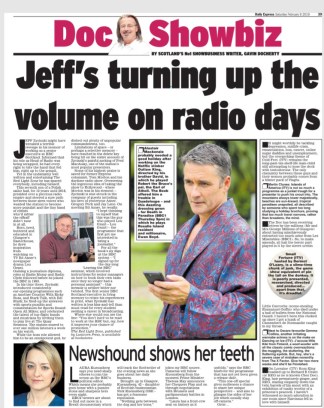
There I go again with my selective quotes from a review, but I’m over the moon with Gavin Docherty’s assessment of my book and the prominence he gave it in today’s edition of the Scottish Daily Express. Of course, I’m ignoring the bits where he gently takes me to task for not saying more about the “painful sacking” of presenters and for not directing more anger towards former BBC bosses. He suggests I had every right to bite the hands that fed me “right up to the armpits”. That did make me laugh out loud.
I’m particularly delighted to be named in the same article as one of my heroes – the actor, Ed Asner, whose TV portrayal of grumpy newspaper editor Lou Grant was one of the reasons I pursued a career in journalism. I have a vivid memory of a particular episode which ended with hard-bitten Lou congratulating one of his young reporters for a job well done and offering to buy him a drink. But on the way to the bar, the reporter notices an old woman struggling in the darkened streets with an odd assortment of luggage so he ask for a rain check on the drink so that he can pursue this possible story. Always be curious, was the lesson I took from that, and always be on the lookout for a story.
Earlier this week I was being interviewed on a fantastic community radio station called CamGlen Radio, based in Rutherglen. The presenter, Cat Gibson, was very enthusiastic about my book and revealed that she had been reading it on the bus and laughing out loud. I’m hearing that kind of comment a lot, which is gratifying, but the needy writer in me always wants to ask which bit they found funny. I don’t, though, just in case they are howling hysterically at one of my serious passages.
During the interview, Cat told me that my old Moray Firth Radio colleague (and now music journalist) Jim Gellatly was mentoring the CamGlen volunteers and teaching them about studio etiquette and how to ‘talk up to time’. She asked me what I thought made a good radio broadcaster. “Authenticity”, was my answer. People relate to presenters who sound like they live in the same world as themselves and whose issues and observations ring true. I often tell students about the time Radio Scotland’s Bill Whiteford was interviewing the BBC business correspondent about the Morrisons’ takeover of the Safeway supermarket chain. At the end of the interview, Bill observed that he didn’t like shopping in Morrisons because they gave you those see-through plastic carrier bags and he didn’t want people seeing what he had bought. I remember listening to that in the car and nodding with agreement. More than that, though, Bill , through that comment, had revealed that he didn’t just live in a radio studio. When six o’clock came, they didn’t pop him into a cupboard until the next day. He lived in the real world and he went shopping like the rest of us.
Similarly, in my short interview with Cat, she revealed that she travelled by bus and that she was a parent. Her presentation style was warm, friendly and, yes, authentic. No need for a posh BBC voice or a fake mid-Atlantic accent, like the teenage me used to put on when I was running a pretend radio station in my bedroom.
But that’s another story.

When I was writing The Red Light Zone, I imagined one of my chums going into a book shop, leafing though a copy, finding their name, reading that bit and then … not buying the damn book. That’s why there’s no index at the back. I know my friends too well. Cheapskates, the lot of them.
However, there are two questions I’ve been asked most frequently since the book was launched just under two weeks ago:
Let’s deal with that first question. I really have no idea what my old bosses are thinking. I’ve heard differing reports, but they range from a sense of mild annoyance that I have dared to laugh at some of the bizarre goings-on I encountered over the past 25 years (and I suspect the bosses in London would be most annoyed by that) to, well, total ambivalence. I’m guessing that with a new TV channel about to launch at the end of this month, the executives in Glasgow have a lot more important things on their mind.
As for that second question. Well, this little video captures just about every name mentioned in the book, including those of pets, The Pope and Santa Claus. Yep, they all do get a namecheck. Of course, I haven’t made it easy. If your name is there, it might pass in the blink of an eye.

The boss was not happy. I had just come back from the studio having read Radio Clyde’s two o’clock bulletin. The legendary Alex Dickson appeared in the newsroom demanding to see the copy I’d written about a local road accident. I had described the two-car crash and given details of the injured parties including the teenage driver of one car and the elderly passenger in the other.
“This elderly passenger, “Alex asked, “What age did you say he was?”
I looked at my script.
“He’s fifty-five, ” I told him, ” I got that from the police….”
“Fifty-five is not elderly,” Alex interrupted, “That’s the same age as our managing director, Jimmy Gordon. Would you call him elderly?”
“Well, not to his face,” I replied, hoping (and failing) to divert his anger with a feeble joke.
Of course when all this happened, I was still in my twenties and anyone over the age of fifty seemed elderly to me. In the years before becoming a parent, I also had trouble at the other end of the age spectrum. At what age, exactly, did infants become toddlers? I’m sure some of my news bulletins had them marching around the house from the day they were born.
All of which reminds me of the Ageing with Attitude season we ran on BBC Radio Scotland back in 2003. We took over the ballroom at the Grosvenor Hotel and various agencies set up their stalls to prove that life could be worth living as you headed into your sunset years. One of the most popular was the chiropodist. We also, as an experiment, sent young reporter Lisa Summers to the BBC’s make-up artists – the same people who aged Ford Kiernan and Greg Hemphill in the early episodes of Still Game. I then took Lisa to the BBC’s costume warehouse and we found a coat and hat just like my Auntie Jean’s. (see the video below) After that, we paraded Lisa around the streets and shops of Glasgow so she could experience the prejudice and discrimination that older people sometimes had to endure.
That was sixteen years ago and I’m happy to report that Lisa Summers, now BBC Scotland’s Health Correspondent, and a regular face on Reporting Scotland, hasn’t aged a bit. I, on the other hand … well, let’s not go there.
I still laugh about that time my father told me it was time to abandon my career with the BBC and help him sell fruit and veg from the back of a van. This is one of those stories about Dad that I had planned to include in The Red Light Zone, but had to leave out because it didn’t fit into any particular chapter. A pity, because those who have read the book say the occasional mention of Dad’s eccentricities are among their favourite bits. Ach well, his life story needs a book of its own.
He told me about his bold plan for my new career on one of those Wednesday nights when I would visit him on my weekly trips to Glasgow. He had the whole thing worked out: he had a nest egg, he explained, the remainder of his redundancy pay-out from the steelworks. He had already bought the van and was surprised I hadn’t noticed it parked in the street outside his house. Not only that, but he was a regular visitor to the big fruit market out at Blochairn and would often pick up crates of oranges or sacks of potatoes which he would share out among visiting family members and neighbours. He knew those blokes at the market, he assured me, and could be sure of getting good deals on the produce.
As I listened open-mouthed to all of this, he led me out into the street to look at his big purchase. It was an second-hand Transit which, he told me, had already been kitted out with shelves and a make-shift counter.
“I’ll do the driving, ” he said, “for a few years anyway. And you can deal with the customers. You’re good with people, radio man, you’ve got the gift of the gabbing.”
I was horrified and couldn’t believe he had taken things so far without even asking me. It was awful to think he had spent his life savings on this old van and I wondered how easy it would be to re-sell it and get some of his cash back. At the same time, I felt terrible guilt at the thought of rejecting him. I wondered if I had been moaning too much about my problems at work. Perhaps that’s why he had decided to rescue me from the world of broadcasting. And, truth be told, there was even a bit of me that was actually considering this new life as a mobile fruit seller. Maybe it wouldn’t be so bad…
At that point, the next door neighbour appeared, murmured a quick hello, climbed into the van and drove off. I turned to Dad. He was laughing so much he could barely speak.
“Good joke, eh?”, he managed to splutter, finally. “Your face is a picture.”
Honestly, if I’d had some rotten fruit in my hand at that point, I would have chucked it at him and chased him down the street.
Even fresh fruit would have sufficed.

Somewhere in the BBC Radio Scotland archives – or perhaps in a toxic landfill site – are more than thirty editions of Teacake Tales. These two-minute stories, read by Hector Auld, were a feature on Tom Morton’s morning programme back in the day and were designed to lead us into the nine o’clock news bulletins with a smile and hopefully take the edge off all the doom and gloom that was to follow. Hector related his memories of ‘Wee Jessie’ and her unlikely childhood adventures in that nostalgic realm of Scotland just north of Brigadoon. She built spaceships out of old prams and premiered a red carpet ‘director’s cut’ version of her hand-shadow shows. Of course, the whole thing was a spoof of the Teatime Tales broadcast by Scottish Television and Hector Auld was played by my multi-talented production colleague Lamont Howie. (He could also do a great impression of Frank Spencer from Some Mothers do ‘Av ‘Em.) I wrote the weekly tales until Neil MacVicar came along with his Angus Dreichmore stories which were ten times funnier.
Those who attended the Glasgow launch party for The Red Light Zone noticed that Tunnock’s teacakes were there in abundance and there was even a choice of milk or plain chocolate versions. I had collected multiple boxes of these from the factory a few hours before the event and even managed a wee peek through the reception window and into the big bakery floor. Oh the aroma! That’s what heaven must smell like.
The teacakes, however, had no connection with Hector Auld and Wee Jessie. They were donated thanks to a daft joke about product placement I had made in the acknowledgement section of the book. The top executives at Lunicorn Press were quick off the mark and made the call to Uddingston asking for the sweet stuff. They also, I believe, made off with the remaining teacakes at the end of the night.
There was one other Tunnock’s connection, though, and I was reminded of it when I was standing outside the factory…and I mentioned it in this wee bit of video.
 Jeff's Zones