“and I’d like to thank the Academy…”

IMG_1481

The Radio Academy, that is, or, to be specific, the Scotland branch of the Radio Academy. Why? Because these fine folk have organised a classy wee event in Edinburgh where Grant Stott will be ‘in conversation’ with me about my book, my career and my views on everything from the BBC network radio’s London-centric commissioning processes to the recent grim news about the dilution of localness in some areas of commercial radio. Free from the shackles of the Beeb I can say what I like about those things, but mainly I’ll be telling funny stories what goes on behind the scenes in broadcasting and, in the main, the joke is usually on me.

The event is being held on Thursday 14th March at 7pm in the Devil’s Cut – which is the stylish downstairs bit of the Angel’s Share hotel. It’s open to the public – not just radioheads – and you can book a ticket through the Eventbrite.co.uk website.

Radio folk, it has to be said, have been very generous with their feedback and reviews of The Red Light Zone…

and there’s a few such quotes in this little video.  Hope to see you on the night.


https://www.eventbrite.co.uk/e/in-conversation-with-jeff-zycinski-tickets-57033216887


They’re in the final!

IMG_E1456

It’s been a good weekend for Team Lunicorn.  I refer, of course, to the dynamic duo of Lyn McNicol and Laura Jackson the creative powerhouse behind  Lunicorn Press.  Lunicorn is probably one of the smallest publishing firms in Scotland but has just been shortlisted as a regional finalist in the prestigious British Book Awards.  The recognition is well deserved because, long before Lyn and Laura got behind my little tome, they were building a loyal fan base of young readers with their tales of Badger the Mystical Mutt.

That good news came on the back of some excellent press coverage for The Red Light Zone and the Inverness launch event. Thanks again to Toby and his team at Waterstones Inverness and to everyone who turned out to see me being quizzed by my old BBC colleague Jo De Sylva.

All of which is just about captured in this short video.


The Grand Tour


Now that Spring is almost upon us – and saying that is a sure-fire way to guarantee blizzards  – I’m looking forward to starting my mini tour of Scotland to promote The Red Light Zone.  It starts this Thursday night at Waterstones in Inverness and through March there are three more Waterstones stores to visit: Aberdeen, Easterhouse and Perth. I’ll also be speaking at the Lochwinnoch Arts Festival and my old radio chums are trying to organise an event in Edinburgh. As if that wasn’t enough, I’ve got two lecture dates lined up. One is with the University of the Highlands and Islands in Inverness, and the other is slightly further afield; it’s in New York. But more on that another time.

I’ve been bowled over by the support I’ve had since we launched the book just three weeks ago. So many kind reviews and mentions on radio stations, blogs and newspapers.

I’ve even heard – but whisper this – that people are actually buying the book and in numbers that outstrip the tally of my friends and extended family.  Real actual readers, in other words.

Anyway, soon be time to hit the road.  My car passed its MOT test yesterday, so that helps.  But in the next few weeks, if you see bedraggled hitch-hiker carrying an armful of paperbacks, please stop.


Pebble Collecting in Easterhouse

waterstones easterhouse


I’m so glad my tour of Waterstones bookshops next month is going to include their branch at The Fort in Easterhouse.  These days it’s not exactly home turf, but certainly the turf of my childhood. I often draw incredulous looks when I tell people that my memories of the place are mostly happy. I laugh thinking about that clump of half a dozen trees off Easterhouse Road that we used to call ‘The Forest’ and how we used to know the names of every neighbour, including their dogs.  Sandy was a gentle Alsatian and Laddie an unusually bad-tempered black Labrador.

Now that I’m a board member on the brilliant Platform arts group, I have good reasonto be in Easterhouse every month or so.  It’s a place that always seems to be changing. Streets are demolished and rebuilt, as are my old schools.  The flat where I was born (my dad delivered me two weeks earlier than scheduled) is still there, although the building has been remodelled and a top storey removed.

About twenty years ago, I made a documentary about Easterhouse and , in it, I told this story about pebble collecting, despite the absence of a nearby beach.


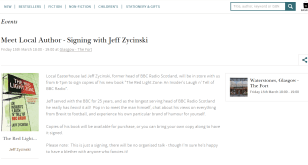
https://www.waterstones.com/events/meet-local-author-signing-with-jeff-zycinski/glasgow-the-fort-64458

And he was ten points in the lead!

Colin Edwards

Colin Edwards, co-creator of the brilliant Franz Kafka Big Band, is also one of my favourite movie bloggers.  In his recent critique of Mary Queen of Scots, he admits that British and Scottish history tends to make him glaze over, especially anything to do with Kings and Queens and succession. I don’t think he’s alone and, were it not for the passion of my late Auntie Jean and Uncle Jimmy, I doubt I would have grown up with any knowledge of Scottish history before World War 2.  It was they who took me and my sister on tours of historic sites and battlefields around Stirling and Clackmannanshire and made the whole thing come alive.

Colin’s musings also reminded me of the time I persuaded journalist and former SuperScot presenter, Jane Franchi, to take part in the radio mocumentary I made about my alter ego, Johnny Sellotape.  In one sequence, Johnny gets a last-minute invitation to appear on this famous BBC Scotland quiz show – a show which tested contestants’ knowledge of all things Scottish – and which regularly attracted record viewing figures.

But much like you can be sure of getting some correct answers on University Challenge by shouting “Shakespeare” , “Beethoven” or “Einstein” at the telly, Johnny had his own game-winning strategy …


Buddies can you spare £8.99?

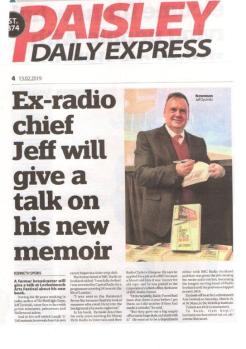
Pailsey Daily Express

Despite appearances, I’m not front page news in today’s edition of the Paisley Daily Express. Blame the cuttings service for that. I’m actually on page 4 and, as the photograph proves, I will need to get back in shape if I’m ever to make it to Page 3.

What I’m enjoying most about popping up in a paper read by Paisley ‘buddies’ is that I know it will cause maximum embarrassment to my daughter, who works in the local hospital there. This is sweet revenge for a story in yesterday’s Herald Diary in which her expertise as a radiographer allowed her to puncture my pomposity during a recent speech.  Asked why I had left the BBC, I told an audience that there is such a thing as a ‘BBC Lifer’ . These are the folk who, it is said, you could cut them open and, much like lettered holiday rock, it would say ‘BBC’ all the way through.  I explained that I never wanted to be a ‘Lifer’ and that if you cut me open it might just say ‘Radio’ all the way through.

My daughter, without recourse to her armoury of x-ray machines and scanners, disagreed . With some authority she vouchsafed the opinion that ‘if you cut my Dad in half, all you would see is fat and gristle.”


Next Year’s News

Next Year's News

I’m looking forward to the launch of BBC Scotland’s brand new television channel at the end of the month and the new News programme – The Nine – boasts an incredible line-up of journalistic talent.  A photograph of that line-up up has been on many websites and newspapers today and it reminded me of the time, back in 1998, when I tried to create the most impatient news programme every devised with a cast of talent that would be able to predict events before they happened.

Alongside journalists like Gary Robertson, Ken MacDonald and Maggie Shiels we recruited astrologer Lynne Ewart, comedian Bruce Morton, footballer and poet Jim Leishman and weather forecaster (and subsequent MSP) Lloyd Quinan.  All our panellists had to do was match their predictions against the views of the public as sampled in an opinion poll.  This Christmas special was intended as a pilot for what would have been called Next Week’s News and the format would have allowed us to test the accuracy of those opinions week by week.

Yet, it didn’t quite work. Too complicated? Too many panellists? A faulty crystal ball? Who knows?

But I’m sure The Nine and the new TV channel will be a roaring success.  At least, that’s my prediction.


A bit off the wall

video conference

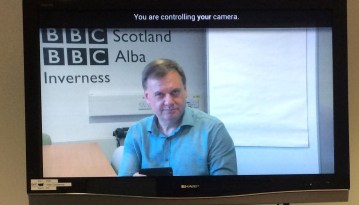
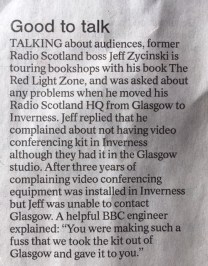
Ken Smith’s diary column in the Herald today picks up the story of my efforts to get video-conferencing equipment installed in the BBC’s Inverness offices. This, I was assured, would spare me from so many car and train journeys to and from Glasgow, but three years after moving Radio Scotland’s nerve centre to the Highlands, there was still no sign of the camera and screen. I stamped my feet, threw around terms like ‘carbon footprint’ and one day, the kit was installed in a meeting room.  It was the same meeting room we used to store boxes of excess toilet rolls, but an angled sitting position and careful positioning of the camera made it look professional. All was not well, though, and it was only when we had tried and failed several times to make a link-up with colleagues in Pacific Quay that a technician explained that “you made such a fuss that we took the gear out of an office in Glasgow and gave it to you.”

Herald Diary Item

At least I never suffered the embarrassment experienced by one of my radio chums who had been booked to make a video-conference appearance at a big management meeting in London.  At the last minute, however, the Director General, Tony Hall, pulled rank and demanded use of that room to rehearse an important and ultra secret presentation about a big strategy shift for the corporation. Alas, someone forgot to cancel the video conference booking and Big Tony (I can call him that now) was well into his hush-hush spiel when my friend appeared on the massive screen, with his cheery face and Scottish voice booming out behind the D.G.’s head.

“Hallo London! Glasgow calling!”

Probably just as well that my friend couldn’t see the expression on the great man’s face.

“Undeniably well written and entertaining … a must read for every student seeking a career in broadcasting.”

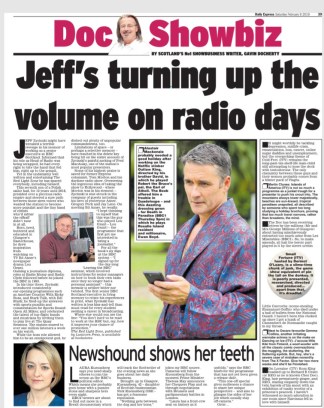
Doc Showbiz RLZ

There I go again with my selective quotes from a review, but I’m over the moon with Gavin Docherty’s assessment of my book and the prominence he gave it in today’s edition of the Scottish Daily Express.  Of course, I’m ignoring the bits where he gently takes me to task for not saying more about the “painful sacking” of presenters and for not directing more anger towards former BBC bosses. He suggests I had every right to bite the hands that fed me “right up to the armpits”. That did make me laugh out loud.

I’m particularly delighted to be named in the same article as one of my heroes – the actor, Ed Asner, whose TV portrayal of grumpy newspaper editor Lou Grant was one of the reasons I pursued a career in journalism.  I have a vivid memory of a particular episode which ended with hard-bitten Lou congratulating one of his young reporters for a job well done and offering to buy him a drink. But on the way to the bar, the reporter notices an old woman struggling in the darkened streets with an odd assortment of luggage so he ask for a rain check on the drink so that he can pursue this possible story.  Always be curious, was the lesson I took from that, and always be on the lookout for a story.

Earlier this week I was being interviewed on a fantastic community radio station called CamGlen Radio, based in Rutherglen.  The presenter, Cat Gibson, was very enthusiastic about my book and revealed that she had been reading it on the bus and laughing out loud. I’m hearing that kind of comment a lot, which is gratifying, but the needy writer in me always wants to ask which bit they found funny.  I don’t, though, just in case they are howling hysterically at one of my serious passages.

During the interview, Cat told me that my old Moray Firth Radio colleague (and now music journalist) Jim Gellatly was mentoring the CamGlen volunteers and teaching them about studio etiquette and how to ‘talk up to time’. She asked me what I thought made a good radio broadcaster. “Authenticity”, was my answer. People relate to presenters who sound like they live in the same world as themselves and whose issues and observations ring true. I often tell students about the time Radio Scotland’s Bill Whiteford was interviewing the BBC business correspondent about the Morrisons’ takeover of the Safeway supermarket chain. At the end of the interview, Bill observed that he didn’t like shopping in Morrisons because they gave you those see-through plastic carrier bags and he didn’t want people seeing what he had bought.  I remember listening to that in the car and nodding with agreement. More than that, though,  Bill , through that comment, had revealed that he didn’t just live in a radio studio.  When six o’clock came, they didn’t pop him into a cupboard until the next day. He lived in the real world and he went shopping like the rest of us.

Similarly, in my short interview with Cat, she revealed that she travelled by bus and that she was a parent.  Her presentation style was warm, friendly and, yes, authentic.  No need for a posh BBC voice or a fake mid-Atlantic accent, like the teenage me used to put on when I was running a pretend radio station in my bedroom.

But that’s another story.
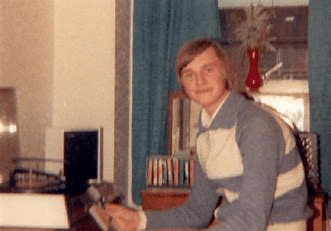
 

jef'z bedroom station