Ageing with attitude

Lisa Summers

The boss was not happy.  I had just come back from the studio having read Radio Clyde’s two o’clock bulletin.  The legendary Alex Dickson appeared in the newsroom demanding to see the copy I’d written about a local road accident.  I had described the two-car crash and given details of the injured parties including the teenage driver of one car and the elderly passenger in the other.

“This elderly passenger, “Alex asked, “What age did you say he was?”

I looked at my script.

“He’s fifty-five, ” I told him, ” I got that from the police….”

“Fifty-five is not elderly,” Alex interrupted, “That’s the same age as our managing director, Jimmy Gordon. Would you call him elderly?”

“Well, not to  his face,” I replied, hoping (and failing) to divert his anger with a feeble joke.

Of course when all this happened, I was still in my twenties and anyone  over the age of fifty seemed elderly to me.  In the years before becoming a parent, I also had trouble at the other end of the age spectrum.  At what age, exactly, did infants become toddlers?  I’m sure some of my news bulletins had them marching around the house from the day they were born.

All of which reminds me of the Ageing with Attitude season we ran on BBC Radio Scotland back in 2003.  We took over the ballroom at the Grosvenor Hotel and various agencies set up their stalls to prove that life could be worth living as you headed into your sunset years. One of the most popular was the chiropodist.   We also, as an experiment, sent young reporter Lisa Summers to the BBC’s make-up artists – the same people who aged Ford Kiernan and Greg Hemphill in the early episodes of Still Game.  I then took Lisa to the BBC’s costume warehouse and we found a coat and hat just like my Auntie Jean’s. (see the video below)  After that, we paraded Lisa around the streets and shops of Glasgow so she could experience the prejudice and discrimination that older people sometimes had to endure.

That was sixteen years ago and I’m happy to report that Lisa Summers, now BBC Scotland’s Health Correspondent, and a regular face on Reporting Scotland, hasn’t aged a bit.  I, on the other hand … well, let’s not go there.
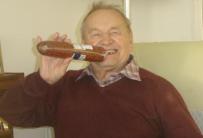


The man with the van and the plan for my future.

Frank Zycinski

I still laugh about that time my father told me it was time to abandon my career with the BBC and help him sell fruit and veg from the back of a van.  This is one of those stories about Dad that I had planned to include in The Red Light Zone, but had to leave out because it didn’t fit into any particular chapter. A pity, because those who have read the book say the occasional mention of Dad’s eccentricities are among their favourite bits.  Ach well, his life story needs a book of its own.

He told me about his bold plan for my new career on one of those Wednesday nights when I would visit him on my weekly trips to Glasgow. He had the whole thing worked out: he had a nest egg, he explained, the remainder of his redundancy pay-out from the steelworks.  He had already bought the van and was surprised I hadn’t noticed it parked in the street outside his house.  Not only that, but he was a regular visitor to the big fruit market out at Blochairn and would often pick up crates of oranges or sacks of potatoes which he would share out among visiting family members and neighbours. He knew those blokes at the market, he assured me, and could be sure of getting good deals on the produce.

As I listened open-mouthed to all of this, he led me out into the street to look at his big purchase. It was an second-hand Transit which, he told me, had already been kitted out with shelves and a make-shift counter.

“I’ll do the driving, ” he said, “for a few years anyway. And you can deal with the customers.  You’re good with people, radio man, you’ve got the gift of the gabbing.”

I was horrified and couldn’t believe he had taken things so far without even asking me. It was awful to think he had spent his life savings on this old van and I wondered how easy it would be to re-sell it and get some of his cash back. At the same time, I felt terrible guilt at the thought of rejecting him.  I wondered if I had been moaning too much about my problems at work. Perhaps that’s why he had  decided to rescue me from the world of broadcasting. And, truth be told, there was even a bit of me that was actually considering this new life as a mobile fruit seller. Maybe it wouldn’t be so bad…

At that point, the next door neighbour appeared, murmured a quick hello, climbed into the van and drove off.  I turned to Dad. He was laughing so much he could barely speak.

“Good joke, eh?”, he managed to splutter, finally. “Your face is a picture.”

Honestly, if I’d had some rotten fruit in my hand at that point, I would have chucked it at him and chased him down the street.

Even fresh fruit would have sufficed.


Who ate all the teacakes?


tunocksteacake

Somewhere in the BBC Radio Scotland archives – or perhaps in a toxic landfill site – are more than thirty editions of Teacake Tales.  These two-minute stories, read by Hector Auld, were a feature on Tom Morton’s morning programme back in the day and were designed to lead us into the nine o’clock news bulletins with a smile and hopefully take the edge off all the doom and gloom that was to follow.  Hector related his memories of ‘Wee Jessie’ and her unlikely childhood adventures in that nostalgic realm of Scotland just north of Brigadoon.  She built spaceships out of old prams and premiered a red carpet ‘director’s cut’ version of her hand-shadow shows.  Of course, the whole thing was a spoof of the Teatime Tales broadcast by Scottish Television and Hector Auld was played by my multi-talented production colleague Lamont Howie. (He could also do a great impression of Frank Spencer from Some Mothers do ‘Av ‘Em.) I wrote the weekly tales until Neil MacVicar came along with his Angus Dreichmore stories which were ten times funnier.

Those who attended the Glasgow launch party for The Red Light Zone noticed that Tunnock’s teacakes were there in abundance and there was even a choice of milk or plain chocolate versions.  I had collected multiple boxes of these from the factory  a few hours before the event and even managed a wee peek through the reception window and into the big bakery floor.  Oh the aroma! That’s what heaven must smell like.

The teacakes, however, had no connection with Hector Auld and Wee Jessie. They were donated thanks to a daft joke about product placement I had made in the acknowledgement section of the book.  The top executives at Lunicorn Press were quick off the mark and made the call to Uddingston asking for the sweet stuff.  They also, I believe, made off with the remaining teacakes at the end of the night.

There was one other Tunnock’s connection, though, and I was reminded  of it when I was standing outside the factory…and I mentioned it in this wee bit of video.


I’m only here for the free pens.

waterstonesposter

Ok, I’m not planning to have tour t-shirts made up just yet, but I thought you might like to know the dates and places where you can come and see me, heckle and chuck rotten fruit.   First up will be Waterstones in Inverness where Jo De Sylva has kindly agreed to host a question and answer session.  I’m told there might be wine. That’s at 6pm on the 21st February.  On the 16th March I’ll be at the Lochwinnoch Arts Festival being quizzed by Professor Rowena Murray. The McKillop Hall is the venue for that, at half past ten in the morning.

Beyond that there as plans afoot for a big event at the University of the Highlands and Islands and at venues in Edinburgh, Perth and Easterhouse.  I’ll keep you updated but I’m warning you now, no moshing or slamdancing will be permitted.

Meanwhile, as it’s the end of the month, a bit of fun. Just over a week ago I was invited on to Grant Stott’s show on BBC Radio Scotland. That meant going into the BBC’s Inverness studio – the offices there were my base for the last twelve years, so naturally I was expecting a warm welcome.

As the video shows, it didn’t quite turn out that way.


I’m no chicken in a real Red Light Zone.

et article

A police radio in my jacket lapel and a fake wallet in my trouser pocket. These were my secret weapons for all those times I would find myself in Glasgow City Centre in the early hours of the morning, walking back to my office or a hotel room near Pacific Quay. It was a half hour stroll (a twenty-minute dash if you had the frighteners) through that twilight zone west of Central Station and under the Kingston Bridge. Comedian and radio star, Des Clarke, also lived out that way and seemed most impressed with my fake wallet idea.
“It has to have some money in it,” I told him, “at least a fiver. And some defunct credit cards or saving coupons for long-gone supermarket chains like Fine Fare or Safeway. You hand this to the mugger instead of your real wallet and he lets you go with a smile.”        Des, it has to be said, had a better idea.
“Or just jump in a taxi and don’t walk in dodgy places after dark.”
Meanwhile, my friend Nicola Creen (confidence guru and former model) was more intrigued with the fake police radio in my lapel.
“So, when the muggers approach,“ I told her, “You thumb the lapel towards your mouth and shout ‘Tango Five Niner. Move In! Move In!’, like you’re part of an undercover sting operation.”
Nicola also suggested the taxi alternative.
In any event, I never did have to deploy either of these tactics, but as revealed by Bev  in today’s Evening Times, I did have to think on my feet when I was approached by a ‘lady of the night’ after emerging from that late-night KFC place on Argyle Street. Convinced that her proposition was the precursor to me being beaten to a pulp in a nearby alley, I rejected her offer with my usual politeness.
“Any other night,” I told her, apologetically, “but I’ve just bought this chicken and I have ten mates waiting for it. They’re in a van around the corner.”
What made this story believable (in my mind anyway) was that I had bought enough chicken for ten people. Less credible was the idea of me having ten mates.
But at least I didn’t have to part with my fake wallet or call in fictional reinforcements.

It’s my party and I’ll buy if I want to


The launch party was going well. Enough people had turned up to make the Sloan’s ballroom look busy and there was the happy chatter of old friends reuniting or strangers making new connections.  Lyn and Laura from Lunicorn Press (my publishers) had arrived earlier in the day to make sure that the wine and orange juice had been sorted and that there was a big enough table for the Waterstone’s people to stack copies of my book for people to buy and for me to sign. I turned up just after five having driven from Inverness with a detour to Uddingston to pick up two dozen boxes of chocolate teacakes, kindly donated by Tunnock’s. I didn’t eat a single one in the drive into Glasgow. Honest!

Comedian and radio presenter, Julia Sutherland, our host for the evening, arrived despite battling a slight lurgy and then other guests started to trickle in: My son, my daughter, my niece Amanda, Innes Smith and Colin Edwards (creators of the Franz Kafka Big Band), Rob Waller (Radio Clyde News), Karen Bartke (Officer Karen from the TV show Scots Squad)  Drew McAdam (mentalist and mindreader), Austin Lafferty (lawyer, artist and all-round good guy) comedy producer Gus Beattie, James McGuire from Capital Radio and so many former colleagues from my days at the BBC – Lisa Summers, Linsday Hil – and from my life before the Beeb.  It was great to see, Claire MacLean (former Clyde colleague) and Kath Caskie, from our student magazine days … and to put faces to names when meeting Sunday Post writer Janet Boyle and book blogger Mary Picken.  So many others too, but I’ll have to name and shame them in future posts.

Julia hosted the night in splendid style, quizzing me about the origin of the book, the reaction of my old bosses, my thoughts on the future of radio and on the soon-to-be launched BBC Scotland TV channel.  She then invited me to read a short extract from my book and I had chosen a section from the Brainwaves chapter, detailing my ill-fated attempt to come up with a quiz format to rival Who Wants to be a Millionaire?  People laughed in the right places, which was a relief.

In the question and answer session, Kath Caskie asked the most difficult question about the difference between the written word and the spoken word.  I waffled . Richard Melvin, meanwhile, set me up with a question about my decision to ban Santa’s a Scotsman, (a festive favourite of Ken Bruce on Radio 2) allowing me to feign outrage for a moment before revealing the true story of our joint attempt to drum up publicity for his Christmas single.

After that, the Waterstone’s men cleared a space on their table for me to sign books and I have to admit that this was the point of the evening when I felt most foolish.  Signing books for friends and colleagues like I was a real author or something!  I managed to come up with a personal and pithy comment for about half of the time and only once did I manage to get someone’s name wrong and have to grab a fresh book from the pile to start again.

Those Waterstone’s boys don’t miss a trick, though. They insisted I pay for the book I had ruined. Still, it was only £8.99.  A bargain, I tell you, a bargain.

So here’s what Grant Stott asked me …

Book in Studio

I’ve done a few radio interviews in the past few days, all with the aim of telling people about The Red Light Zone (which is launched tomorrow) . On A1 Internet radio, the presenter Chris Grant took seriously ill just before I went on air and handed over to his co-host in Madeira.  As the minutes passed, Chris was sending us text messages telling us that he was in severe pain and was being admitted to hospital there and then. Happily he was back on his feet the next day.

A few days later, I was on air with  Dave Hodgson on Talk Radio Europe and backed myself into a conversational cul-de-sac about sausages.

This afternoon I was on BBC Radio Scotland, talking to Grant Stott who managed to cover my thirty year career in the space of fifteen minutes, pausing only for an archive clip of  Johnny Sellotape and then allowing me to read an extract from the book itself.  I told that Princess Anne story again.

Then Grant asked me what the BBC bosses thought when I told them I was going to write about life behind the scenes in radio …


In The Zone


“The Marketing team put together a fun promo showing a kitchen radio bursting open with all this extra content. Speaking to members of the Scottish Parliament, the Director General Mark Thompson said that the audio zones were an intelligent and imaginative response to the challenges that Radio Scotland faces.”

The Red Light Zone (Chapter 22)

Let’s see who’s sharing a birthday with Adolf.

dan o'day

Dan O’Day used his library of audio clips to illustrate the dos and don’ts, based on things he had heard, admired or cringed at from radio stations all over the world. One example was that hackneyed feature The Birthday List, when a radio presenter gave a roll-call of famous people – dead and alive – who might also be sharing a birthday with you on that day.  But who, asked Dan, as he fired a clip of a bored presenter going through the motions, really wants to know that “… also born on this day was notorious Nazi, Adolf Eichmann, responsible for implementing Hitler’s Final Solution that led to the murder of millions of Jews.”

It was a fair point. You would have trouble shoe-horning that into the conversation at coffee break.


-The Red Light Zone (Chapter 12)

Dan’s website


“It is a tale told by a supreme anecdotalist, an excellent journalist, a very accomplished writer and a man who could, and did, drink me under various tables on many occasions.”

tom morton shetland

Once again I’m being selective in my choice of quotes from a review, but this one from Tom Morton in The Scottish Review is mostly positive … and I’m trying not to be more flattered by his assessment of my drinking prowess, because that would be just too stereotypically Scottish. Besides, that’s all in the past now. Hic.

Here’s the full article …

http://www.scottishreview.net/TomMorton462a.html