The Mix Tape Mix-Up

drew carson show

It was good fun chatting to Drew Carson, host of the Drew Carson Show on Radio Haver. If you haven’t heard of Radio Haver, I urge you to check it out. It’s an ambitious internet station with a compelling mix of interview shows and music formats and all aimed at the artistic community in Glasgow and beyond. It also plays host to podcasts made by others who share Drew’s aim to offer smart but accessible programming.

Drew Carson linked up with me on Skype to talk about my book, about the future of podcasting, about local journalism, politics, drama and the dangers of getting on the wrong side of egotistic musicians when interviewing them. Drew once had death threats after a show!

At one point, when we were talking about the skills involved in programming a music show, Drew reminded me of the days when we used to make mix tape compilations on cassettes – usually for those special people in our lives or, in my case, a girl at my school who I could only admire from afar.  Have a listen to this wee clip  and then check out Radio Haver for all the other shows in their schedule.

radiohaver.com


Dan, the radio guy.


One of the best moments of this whole book-writing business (so far) was when I was interviewed by one of my top radio heroes, Dan O’Day.  Dan describes himself as just a ‘radio guy’ and never as a consultant – although he has spent many years travelling the globe, sharing his knowledge at radio stations and festivals or holding workshops and seminars in the United States .

I make several mentions of him in The Red Light Zone, because I learned so much from him about what works and what doesn’t on air. It was at one of his two-day events in Hollywood that I was taught the technique of finding and writing comedy by mining memories of things you’d probably rather forget. As Tom Morton pointed out in his review of my book, that’s a theme of many of the stories I tell.

A few week ago, Dan linked up with me from his home in Los Angeles and we just talked…and talked…and talked.  I should warn you, us radio people like nothing more than talking about radio.  Our conversation lasted more than two hours, but I’ve shown you mercy and edited just a half hour section.  Dan has a longer version on his Facebook site and if you want more information about him, go to danoday.com

http://www.danoday.com/

http://www.scottishreview.net/TomMorton462a.html


Easter Thanksgiving

Thankyou Slide (2)

This being the Easter weekend, it seems like a good moment to pause, take a breath and reflect on the past twelve weeks or so since we launched the Red Light Zone into the big bad world.  In that time I’ve been travelling up and down the country, speaking in bookshops and village halls and being interviewed by people as far afield Spain and Los Angeles.

I have to say, I’ve loved every minute of it and I really don’t know why some authors complain about the publicity circuit. It’s much more fun than sitting at home watching daytime television and trying to decide whether to invest in a memory foam mattress or a easy-payment funeral plan. Perhaps one leads to the other.

I have a ton of photographs, newspaper cuttings and, more importantly, people to thank. So I’ve bundled all of those things into this one little video. Sorry if  I’ve forgotten anyone. Let’s just assume you’re in there somewhere and, if not, I’ll get you next time.

Happy Easter.


Is Nick wasting his time?

It takes some guts to stand up to the very rich and the very powerful, so I’m glad we’re now in summer hat-wearing weather. Why? Because I want to take mine off to a chap called Nick Osborne. I’ve never met Nick and, until a few days ago, I had no idea that he was a morning show host on a Sussex radio station. Nor did I know that he was the mysterious figure behind the Local Radio Group and a campaign organised in the wake of Ofcom’s decision to change the rules about local broadcasting. These new rules – yet to be formally approved by Government, but already being taken advantage of – allow big radio owners like Global to dispense with local breakfast shows, to network more content across the U.K. and to co-site stations in central hubs like London or Glasgow.
Now you may think this is the inevitable evolution of the industry in the U.K. These stations are commercial entities after all and there can only be so much room for sentiment and nostalgia in a sound business plan. You might, like me, feel sorry for the presenters and backroom staff who might be losing their jobs. Or you might simply be confused and wonder why your local radio station seems to be disappearing bit by bit.
In any case, there’s surely a debate to be had and some questions to be posed and that’s where Nick came in. Rather than shaking his head, sighing and mouthing ‘tut tut’ , Nick organised a small survey of a thousand-odd people on social media and that formed the basis of a report which he compiled in his own time and with his own money. It wasn’t perfect, by any means, and a bit of a pea-shooter compared with the heavy artillery of research and reports that commercial radio owners had deployed to strengthen their case for change. I suspect Nick’s passion for the issue allowed some of his facts to be blurred by opinion. Nevertheless, I had no regrets when he included my own thoughts in the appendix. I no longer work in radio, so don’t have to care about offending the regulator or worrying my employer. Easy for me, but not everyone can be as courageous as Nick.
And what was the response to the report? Well, a lot of ‘ likes’ and comment on Twitter and so on, but not much pick-up from the media, not even the industry website Radio Today – until, that is, someone asked why they weren’t covering the report. The Tweeted response from RT’s Roy Martin -now no longer available – was dismissive. It criticised the author’s (then) anonymity, referred to spelling mistakes and said it had landed in Radio Today’s spam filter. Surely not Nick’s fault?
There was more to come. The RT podcast this week did mention the report in passing but suggested that the Local Radio Group was “wasting its time” and was maybe a one-man band. Nick wasn’t mentioned by name, but the podcast host had gone out of his way to sample a bit of Nick’s morning show in Sussex and declared that it didn’t have much local content. Oh, how ironic – if only that was true. The evidence of my own ears tells me differently. As I say, Nick wasn’t mentioned by name, but when the podcast had been discussing Global Radio’s move into billboard advertising, then Roy Martin seemed to be on first name terms with “Steven and Ashley and the rest of the team”. All very cosy, but not surprising to those of us who have attended the Radio Festival or Radio Academy and witnessed the mutual back-slapping and scratching among radio’s London-centric power-elite and their hangers-on.
So is there still any love left for local radio? As it happens, here in Scotland, I’ve recently spent some time in commercial radio stations and the enthusiasm for connecting with communities seems undiminished. At MFR in Inverness, for example, I was barely through the door when I encountered the Cash for Kids team busy allocating grants to local charities. At Heartland FM in Pitlochry, the staff were still buzzing about a local music festival. In the Central Belt, the Bauer stations are taking advantage of Global’s retreat from localness by flashing ‘Live from Edinburgh’ and ‘Live from Glasgow’ in their promotions. It also seems that politicians in Scotland are taking the issue more seriously than their counterparts in Westminster, but there of course, Brexit is pushing so many other things to the side-lines.
So yes, hats off to Nick Osborne and, to be clear, the Local Radio Group is not a one-man band after all.
There’s at least two of us now.

Don’t tell The Queen.

Colin MacPhail

One of the many fringe benefits of writing a book with an associated website is that I’ve been contacted by  many old friends, colleagues and acquaintances.  There was Mary McCarthy who I last spoke to at St Collette’s primary school in, let me see, 1975. She’s now a journalist in Spain.  Then there was Stephen Davren, a chum from college days who sent me those pictures of his teddy bear enjoying my book. And now, from way across the Atlantic, up pops Colin MacPhail (pictured), former producer with BBC Radio Scotland’s Tom Morton Show.  He left Inverness to pursue American adventures in forestry, then gin-making and now is the owner of the Vinfabula consultancy in California and writes extremely funny and informative articles about wine under the heading Cabernet Confidential. This, for instance, is some of his advice for the would-be connoisseur:
“Rule #3 – Stop and think. One of the great blessings of wine is it causes us to pause in our busy lives and savor the moment and how lucky we are to enjoy it. Take your time. If you have a long day ahead, spit the wine out into a spit bucket. That’s OK. If you have a designated driver you can forge ahead on your sampling. Taste too much and you are doing something called “drinking.” That you can do at home.”
That line about tasting too much reminded me of a trip I made to Washington State back before the turn of the century. This century, I mean, not the one before. Turn of the millennium really. It was one of those press junkets organised by the tourism people in Seattle and my news editor at Radio Clyde must have been in a good mood when he nominated me for the week-long jolly.  As I recall, there was about eight of us on the trip. I was one of two radio reporters and the others were London-based newspaper or magazine journalists. We were ferried hundreds of miles in a luxury mini-bus and shown the delights of the Seattle grunge scene, got to do horseback riding in an upstate ranch (in a thunderstorm) and given the VIP treatment in a Washington winery.  I mean, we were really welcomed as Royalty, with the management and guides addressing us collectively as Her Majesty’s British Press and, initially, at least, treating us with the deference they might have shown to the Queen herself.
At this point I should admit that we sustained ourselves on these long bus trips by passing around a bottle of Jack Daniels which we washed down with more Jack Daniels, so by the time we arrived at the posh winery we were already in the party mood.  Nevertheless, for the first few minutes we listened respectfully and attentively as our guide told us about the history of wine production in Washington, about soil conditions and grape varieties and then proudly poured sample after sample of their various products. There was no question of us tasting and spitting, we drank like we were on the eve of Prohibition and asked for refills. Polite murmurs of appreciation soon gave way to raucous laughter. Crystal flutes held properly by the stem, soon slipped from our fingers. The subsequent raised voices and the sound of shattering glass made me feel very much at home. Like I was back in Glasgow: The Horseshoe Bar, perhaps.

Sooner than scheduled, a Seattle P.R. representative was scooping us back on to the mini bus and we were being waved off by the open-mouthed staff. Don’t ask me to tell you the name of the place. Everything after that was a blur.

I just hope the Queen never finds out about that trip.

Everyone counts, or no one counts.

Bosch

A few days ago my publishers relayed some feedback from a satisfied reader.  She said she had enjoyed The Red Light Zone and had felt that my style of writing made it feel that my words were aimed directly at her, like I was telling my stories to just one person. Then, perhaps because she is a fan of the genre, she added that she wished I would write crime fiction. Oh, if only!

I’ve been a fan of crime and detective stories since I was old enough to join the junior library in Easterhouse.  The Hardy Boys and Alfred’s Hitchcock’s Three Investigators soon gave way to the classics: Sherlock Holmes, Agatha Christie’s Poirot and then Raymond Chandler’s wise-cracking Philip Marlowe (“she tried to sit in my lap but I was standing up.”)

These days I devour anything by Michael Connelly, especially the novels featuring Harry Bosch whose quest to seek justice for murder victims  is driven by a simple yet powerful  philosophy: everyone counts or no one counts.  The Bosch TV show (a new series soon to be aired on Amazon Prime) is pretty good too.  I’ll be binge watching that while the rest of the world is immersed in Game of Thrones.

And so to Tom Morton, my friend and former colleague, who has just written a thought- provoking article about crime fiction in the latest Scottish Review.  His musings were sparked by the recent Shetland TV series which is set, of course, on the islands that Tom has made his home for the past umpteen decades.  He concludes his article by saying he finds it difficult to distance himself from the make-believe murder on the small screen when it seems so close to home.  Perhaps that’s why I also avoid those hard-bitten tartan noir tales set in Glasgow.

And could I ever turn my hand to crime fiction? I doubt it.  Apart from anything else, there are too many good writers in that field and if you want some recommendations then you could do worse that read Mary Picken’s Live and Deadly blog, which has been nominated for an award.  Or try some Manc Noir in the form of my friend David Nolan’s latest book Black Moss which begins in the same era of commercial radio as my own memoirs.

As for me, my slight and secret nod to the genre came in the Chapter Six of The Red Light Zone as I told the true story of a car chase in Los Angeles while we were out there broadcasting live editions of Tom Morton’s show from Hollywood. This was 1996 and our engineer, John Carmichael, took some of the VHS location footage which I’ve mangled and repurposed as the backdrop to this little extract.


Return to MFR


Have you ever wondered what it would be like if you could go back in time and do your old job  but still keep the knowledge you have gained over, say, the last thirty years?Would you be better at it or worse?  Well, today, I got the chance to find out when I visited MFR (Moray Firth Radio as was) in Inverness.  A lot had changed; the layout of the building, the equipment (except the engineer’s bay was the same mass of cables and spare parts that I remember) and the staff were now so much younger than me.

Content Director, Davey Walker, gave me the guided tour.  I met Jodie McCluskey, presenter of the lunchtime show, and news reporter Isla Todd, who told me she was reading my book and had got to the bit were I was applying for the position as Head of Radio at BBC Scotland.  I didn’t tell her how that worked out. No spoilers.

Then Davey invited me to try my hand at reading a news bulletin. That’s when stage fright almost got the better of me…as you can see in this video.


In case you missed it…I was shocked.

It wasn’t quite a Twitter storm, more like a stiff Twitter breeze, but my thoughts on the future of local radio did bounce around social media for a time this afternoon after my interview aired on Heartland FM.   They came after an enjoyable twenty minutes or so as station manager Alistair Smith led me skilfully through my career in radio and allowed me to describe how I came to write a book about it.  I got to talk about that recovered footage of Let’s do the Show Right Here in Aberfeldy which I told you about a few posts back. We talked about music, transmitter blackspots on the A9 and a mythical Jacuzzi in the Heartland studio.  Then just as we were wrapping up, we got into this whole business of how Ofcom was allowing big commercial radio companies to dilute local content and broadcast U.K. wide breakfast shows out of London. Well, I didn’t need to be asked twice.  I used words like “shocking” and “outrageous” and said that the regulator Ofcom was left doing nothing except policing bad language.

Within minutes my words were being tweeted and re-tweeted and the Local Radio Group who are campaigning to save local content got in touch asking me to lend my weight (steady! I’m just wo days to my summer diet) to their efforts.

I happily agreed.

So, if you missed the interview, Heartland FM have made it available on this slick little podcast.


The Voice of Highland Perthshire


Driving south on the A9 towards Perth, there was a time when there was only one radio station you could listen to, and that was Heartland FM broadcasting out of Pitlochry.  You started to pick it up around Dalwhinnie and listen all the way into Perth city centre. It remains one of the best community based stations in the U’K. and is an excellent source of information if you find yourself stuck in a traffic tailback.

Last week, I finally managed to wangle my way into the Heartland FM studios – now located on the main Atholl Road in the centre of Pitlochry.  Station manager Alistair Smith gave me the guided tour and, as every radio manager does, began with the computer server and other technical gubbins that allows the stations to be heard locally and around the world.  I suspect it’s only radio people who are fascinated by this stuff.

I recorded a long interview with Alistair and he did likewise with me. This wee video gives you a wee flavour of what you can hear and see.


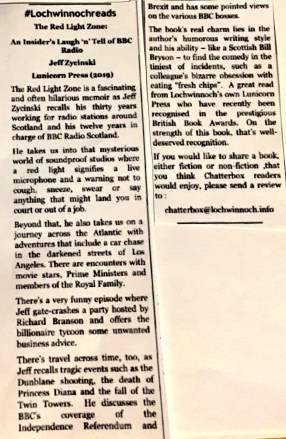
“Like a Scottish Bill Bryson”

Chatterbox Review

I’m now in love with Lochwinnoch and everyone in it and every house, shop, pub and paving stone. Especially the pubs, though.  I was last in the village for the arts festival there and you would be forgiven for thinking I either bribed, hypnotised or drugged the editor of the local newsletter, Chatterbox.   Bill Bryson is my hero and inspiration. I just hope he doesn’t spot this.